
What water ripple stainless steel is
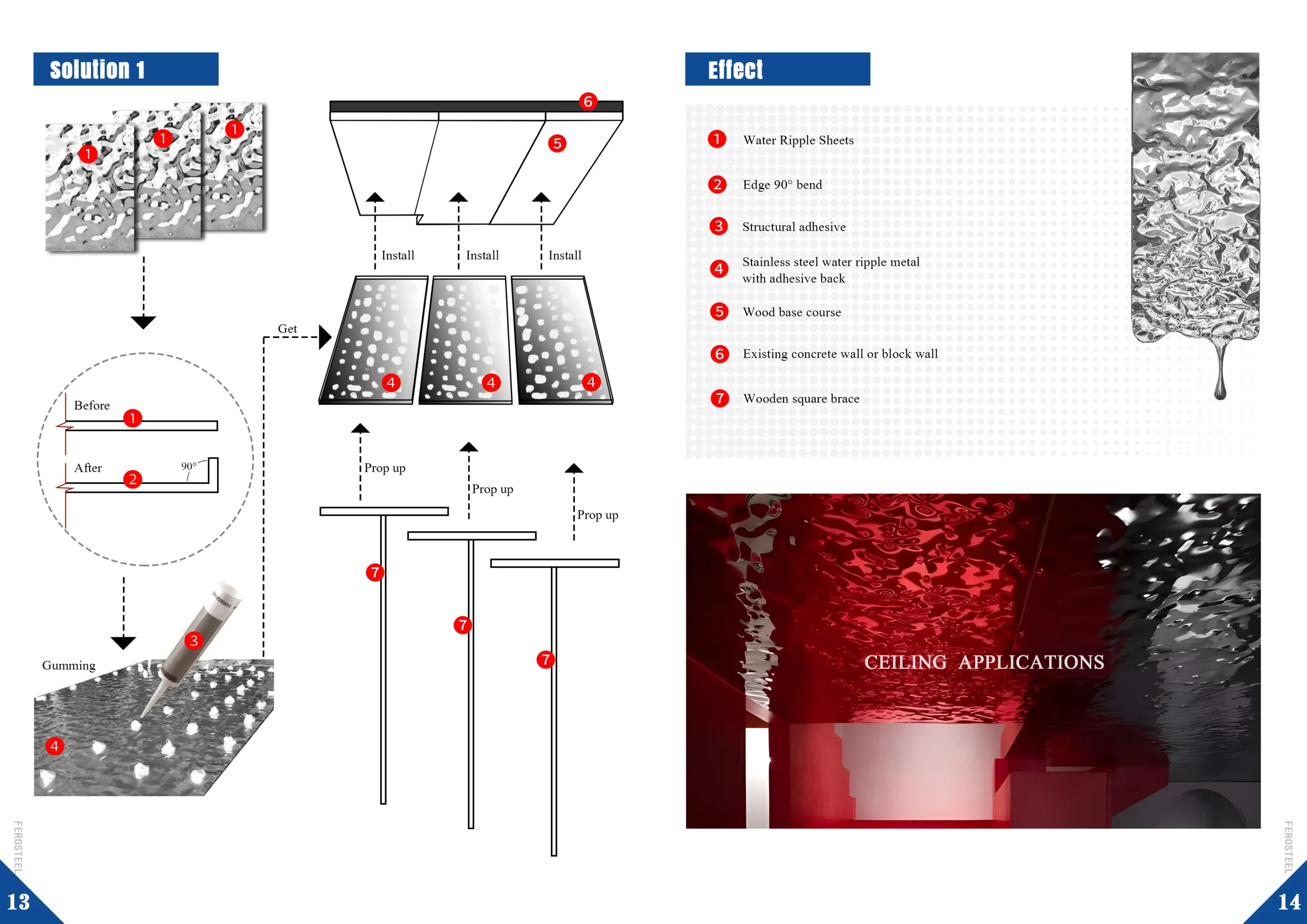
Water ripple sheet is stainless steel that has been roll-formed or pressed into a regular wave pattern. It keeps the strength and corrosion resistance of the base metal while adding a three-dimensional surface that reflects light in bands. Common bases are 304 and 316L, with mirror, hairline or PVD-coloured top surfaces.
The specification decisions
- Ripple size — small, medium and large wave pitches create very different visual density at the same viewing distance.
- Pattern direction — the ripple can run with or across the long edge of the sheet; consistency between panels is critical.
- Base finish — mirror gives sharp reflections; hairline softens them and hides minor installation marks.
- Panel layout — plan the grid so the ripple lines continue across adjacent sheets, or deliberately break them with a reveal.
Typical ceiling specification range
| Parameter | Typical value / options |
|---|---|
| Base grade | 304 (interior), 316L (humid or coastal locations) |
| Thickness | 0.5–1.2 mm for ceiling panels; thicker for large spans |
| Sheet size | 1219 × 2438 mm, 1000 × 2000 mm; cut-to-size available |
| Ripple pitch | Small / medium / large; confirm with physical sample |
| Surface | Mirror No.8, hairline No.4, PVD colours |
| Backing | Optional acoustic backing or honeycomb support for large panels |
| Fixing | Hidden clip system, screw fixing through flange, or adhesive to substrate |
| Packing | Protective film, inner carton, export wooden crate |
Getting a continuous ripple across the ceiling
The most visible mistake on a water ripple ceiling is a pattern that changes direction between panels. Agree a layout drawing before production: mark the ripple direction on every sheet, number the panels, and install them in that order.
Lighting matters as much as the sheet
A ripple ceiling is a reflective surface. Linear lights running parallel to the ripple reinforce the wave; lights across it flatten the effect. Test a mock-up with the actual fittings before committing to the full ceiling.
Allow for handling
Keep the protective film on during installation and remove it only after the area is clean. Thin ripple sheet can deform if supported only at the edges — plan sufficient backing or framing for wide panels.
Frequently asked questions
Does water ripple sheet need a backing for ceilings?
For small panels fixed to a solid substrate, no backing is usually needed. For large spans or panels fixed only at the edges, an acoustic or honeycomb backing prevents oil-canning and keeps the ripple uniform.
Can the ripple direction be controlled?
Yes. Ripple direction is set during production. State the required direction on the drawing and confirm it on the approved sample, then number panels so installers follow the layout.
Is water ripple stainless steel suitable for humid areas?
Use 316L base for high-humidity or coastal locations. Keep the surface clean and avoid harsh chlorides; the ripple shape itself does not reduce corrosion resistance when the correct grade is used.
How do I clean a water ripple ceiling?
Wipe with a soft cloth and mild detergent along the direction of the ripple. Avoid abrasive pads, which can scratch the peaks and make the reflection patchy.